
Revenue leakage in healthcare has many origin points. Catching something as granular as one patient status decision, incomplete clinical record, coding discrepancy, or undelivered payer response could prevent myriad issues upstream.
That makes revenue leakage difficult to solve with isolated fixes.
New research conducted by Qualtrics for Waystar suggests fragmentation remains the norm across the mid-revenue cycle.
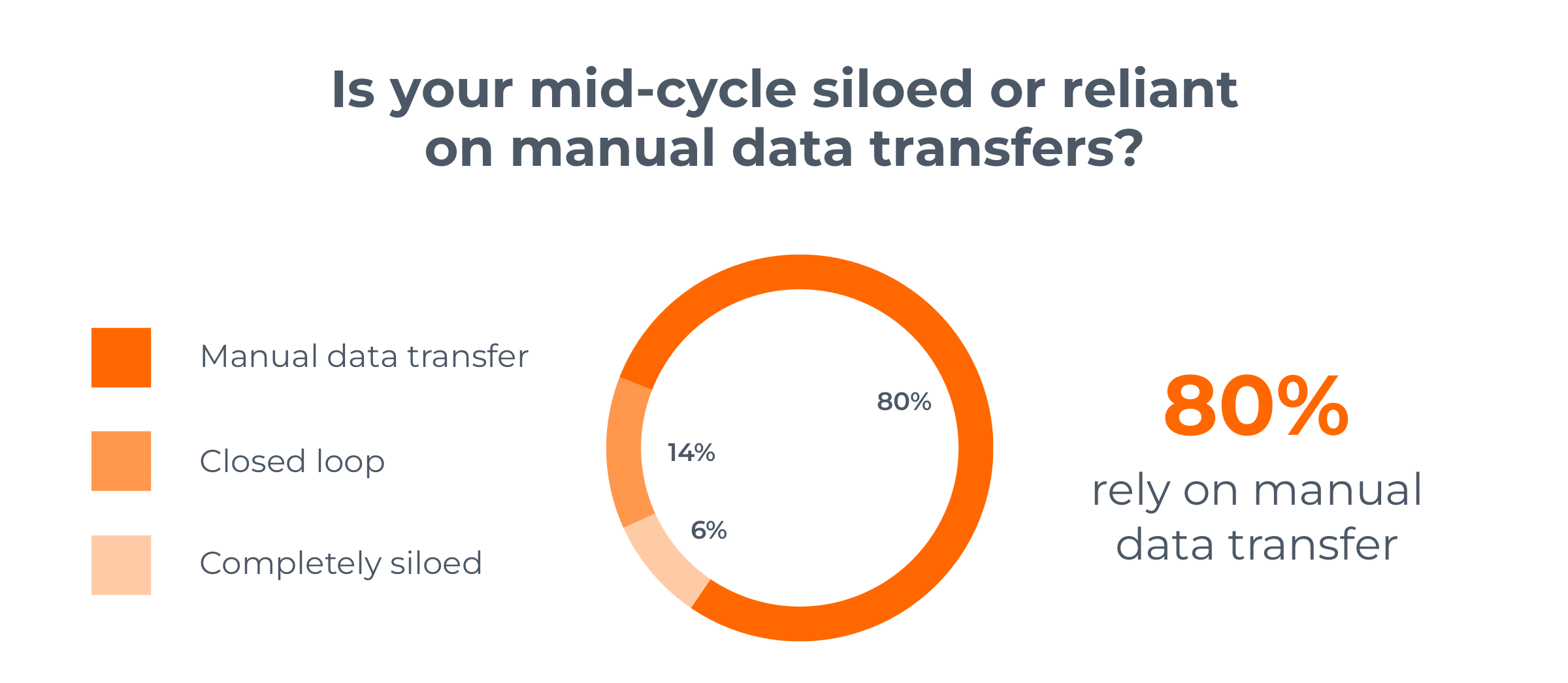
In a 2026 survey of CFOs, revenue cycle executives, and mid-cycle leaders, 86% report that their mid-cycle and claims systems are siloed or require manual data transfers.
That creates blind spots between clinical decisions, claims outcomes, and actual payment.
So how can healthcare organizations tell when fragmentation is putting earned revenue at risk? Here are five signs your mid-cycle may be causing revenue leakage.
REVENUE LEAKAGE IN HEALTHCARE RISK:
1. Your teams still move data between systems manually
One of the clearest indicators of fragmentation is also one of the most common.
Waystar’s research found that:
- 14% of organizations have a closed loop between their mid-cycle and claims systems
- 80% manually move data between those systems
- 6% report that the systems are completely siloed.
Manual handoffs make it harder for teams to work from the same information at the same time. More importantly, they disconnect upstream decisions from downstream results.
A UM team may determine the right patient status, CDI may strengthen the clinical record, and revenue integrity may uncover a coding or charge opportunity. But without a feedback loop connecting those actions to the resulting claim, payer response, and payment, organizations have limited visibility into what worked — and fewer opportunities to prevent the same leakage from recurring.
REVENUE LEAKAGE IN HEALTHCARE RISK:
2. Multiple point solutions can’t deliver one view of performance
Healthcare organizations have no shortage of revenue cycle technology. But more tools don’t always mean greater visibility — especially when each tool operates with only part of the story.
Of surveyed organizations, 66% rely on multiple vendors for their mid-cycle technology strategy while just 14% use a single platform. Overall, 68% say lack of mid-cycle integration with their primary financial or claims platform is a top source of frustration.
When two-thirds of organizations evaluate performance in slices:
- Clinical teams can only see documentation and patient-status information
- Revenue integrity teams can only see coding and charge opportunities
- Claims teams can only view payer responses
- Finance teams only see final reimbursement
Without a shared view across those workflows, the organization can’t answer critical questions, such as: Where is revenue being put at risk? And how can we prevent that risk from recurring?

REVENUE LEAKAGE IN HEALTHCARE RISK:
3. Downstream outcomes rarely change upstream workflows
Finding a revenue opportunity is valuable. Using that insight to improve the next case is where the impact compounds.
Waystar data shows what earlier, more connected action can deliver:
- 36% more OBS-to-IP conversions before the first midnight
- Less than 2% medical necessity denial rate
- Faster patient-status decisions that give CDI teams more time to strengthen documentation before discharge
Genesis HealthCare System saw that shift firsthand
With 13,000–14,000 annual admissions, limited bed capacity, and a highly manual process, Genesis began using Waystar’s AI-powered capabilities to help UM and CDI teams prioritize the right cases and act sooner.
That led to:
- A 98% review rate
- Roughly $4.9M in revenue gain from identifying appropriate inpatient versus observation cases
- Faster coordination between UM, CDI, and physicians on patient status and supporting documentation
That feedback loop is helping teams turn downstream insight into upstream action — addressing payer-specific issues faster, catching status mismatches earlier, and reducing the chance that the same revenue risk repeats.
How Genesis gets to the right level of care, faster
REVENUE LEAKAGE IN HEALTHCARE RISK:
4. Revenue opportunities are still identified after the best time to act
Retrospective review has an important role in the revenue cycle. But when revenue risk is only identified after discharge, billing, or payment, the organization has limited opportunities to change the outcome.
The mid-revenue cycle creates an important window for earlier intervention.
Report data shows how AI-powered:
- Utilization management can identify likely patient status sooner
- Clinical documentation integrity can extend documentation review across cases
- Revenue integrity capabilities can then identify potential charge, coding, and documentation anomalies before the claim is submitted.
In one early-adopter example, AI-powered anomaly detection helped identify $3 million in revenue per 10,000 admissions prior to the claim.
The shift is significant. Instead of finding revenue after it has leaked, teams can now identify the risk while there’s still time to act.
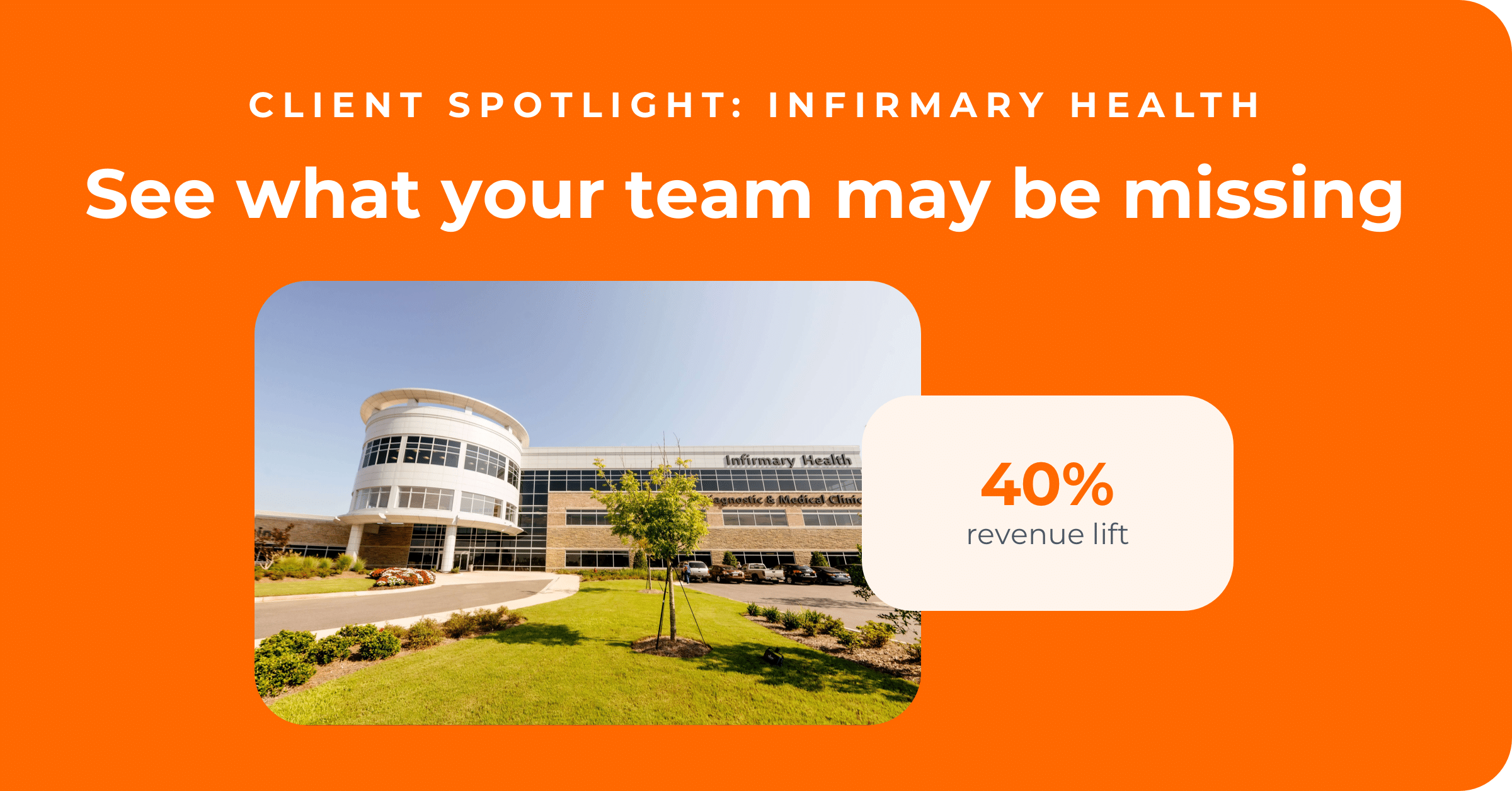
Infirmary Health scaled CDI with limited resources while gaining visibility into charts the team hadn’t reviewed — helping uncover appropriate revenue opportunities that may otherwise have been missed.
REVENUE LEAKAGE IN HEALTHCARE RISK:
5. You can measure estimated lift — but not realized revenue
A reimbursement opportunity isn’t the same as revenue received. And when multiple vendors touch the same account, more than one may attribute the same payment to its ROI.
A connected approach provides a clearer path to true financial impact:
- Connect mid-cycle actions to payer contracts to determine net opportunity
- Connect that opportunity to final payment to calculate realized revenue
- Measure actual dollars received, not just estimated lift
The report’s ROI model shows the difference: Individual mid-cycle functions often measure estimated lift across limited portions of the patient journey, while an end-to-end platform can connect activity across 100% of patients to realized revenue.
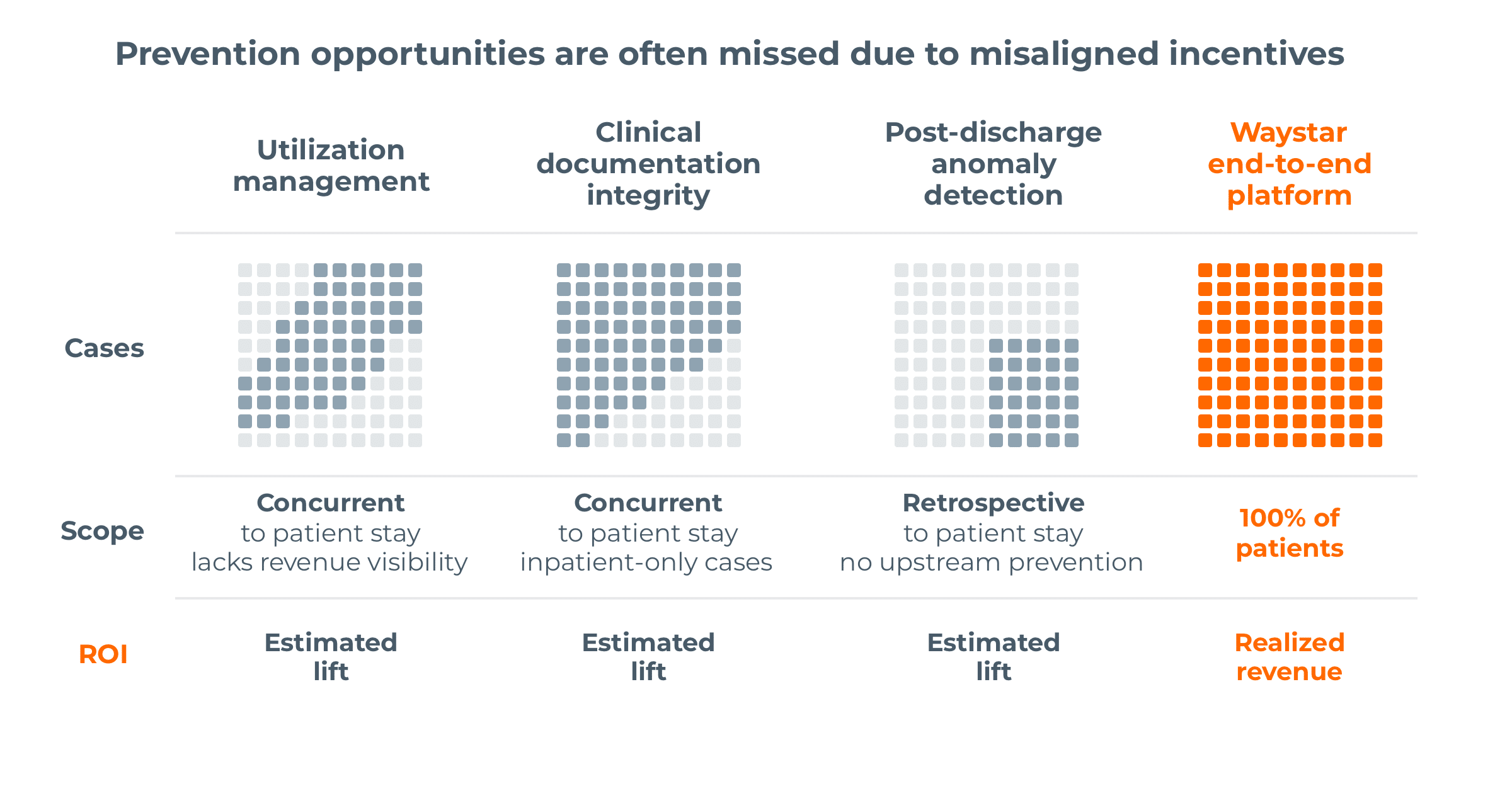
That visibility helps organizations understand which interventions are actually stopping revenue leakage — and which investments are delivering measurable returns.
How Infirmary Health connects CDI impact to measurable ROI
A connected mid-cycle closes gaps
Fragmentation makes it harder to see where revenue is at risk, act early, and measure what’s actually recovered. Connecting financial + clinical intelligence across the mid-cycle gives organizations greater visibility to prevent leakage and capture earned revenue.
Explore The state of the mid-revenue cycle for new survey findings, client outcomes, and five insights for building a more connected approach.
Ready to see how Waystar’s AI-powered platform can help your organization stop revenue leakage in healthcare?
Discover the way forward.