
Rural hospitals and providers play an essential role in keeping care close to home for the communities they serve. As healthcare organizations navigate increasing financial pressure due to fluctuations in Medicaid and ACA coverage as well as regulatory changes, many are exploring practical ways to strengthen financial performance, reduce administrative burden, and build a more sustainable path forward.
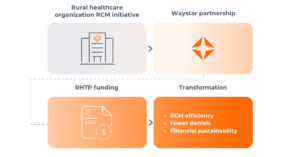
The Rural Health Transformation Program (RHTP) creates funding for rural healthcare organizations to do a number of things, including addressing administrative burden by launching revenue cycle initiatives to improve efficiency and strengthen financial performance.

What is the RHTP (Rural Health Transformation Program)?
Created to support rural care delivery, the RHTP will allocate $50 billion in funding to 50 states over five fiscal years, beginning in 2026 and continuing through 2030.
While each state RHTP differs, many allow funds be used to help organizations:
- Enhance operational efficiency
- Improve financial stability
- Sustain access to essential healthcare services
- Reduce administrative burden
- Strengthen long-term organizational resilience
How to use RHTP funds
Many are asking how to use RHTP funds granted by the state in their organization. The good news: many revenue cycle initiatives align with their state’s RHTP focus on operational efficiency and financial stability.
As rural providers navigate reimbursement reductions and volume changes, revenue cycle optimization can play an important role in preserving financial health. Investing in the latest AI-powered RCM technology can help organizations create a stronger financial foundation.
Use RHTP funding for advanced technology that:
- Reduces denials
- Finds hidden coverage
- Increases net patient collections
- Accelerates reimbursement
- Decreases days in AR
- Improves staff productivity
- Strengthens long-term financial sustainability
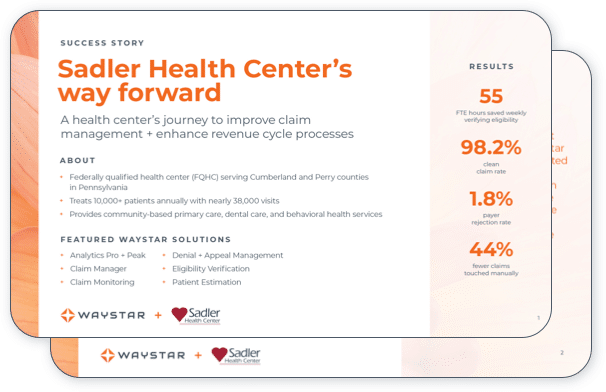
How Waystar supports RHTP goals
Waystar helps rural healthcare organizations align RHTP funding with your organization’s goals to support revenue cycle improvement.
By reducing manual work, strengthening reimbursement performance, and helping protect financial sustainability, Waystar solutions can support the operational efficiency and financial sustainability RHTP exists for. With connected software and deep RCM expertise, Waystar helps organizations identify high-impact initiatives and turn funding opportunities into meaningful results.

Get started while funds are still available
Keeping rural healthcare viable has never been simple. Sustaining access to care in rural communities requires constant focus, thoughtful investment, and operational efficiency.
With significant funding for rural healthcare already rolling out across the country, now is the moment to identify high-impact revenue cycle initiatives that can help strengthen stability and support long-term access to care in your community.
We’re here to help.
Waystar’s experts can help align your revenue cycle goals with RHTP funding opportunities and walk through the application process with you.
10 allowable uses under RHTP + potential solutions
The RHTP names 10 categories of allowable use, and every state must fund three or more. Check out all 10 categories below, find your state’s guidelines here, and discover Waystar solutions that may qualify.
1. Chronic disease prevention and management
Evidence-based programs that prevent and manage chronic disease in rural populations.
2. Payments to providers for items or services
Direct payments to rural healthcare providers, capped at 15% of a state’s annual award.
3. Consumer-facing, technology-driven solutions
Tools patients use directly to prevent and manage chronic disease.
Patient Payments Patient Estimation
4. Technology-enabled solutions in rural hospitals
Training and technical assistance to adopt remote monitoring, artificial intelligence, and robotics in rural hospitals.
Authorization Manager Denial + Appeal Management
5. Clinical workforce recruitment and retention
Recruiting and keeping clinical talent in rural areas, with a commitment to serve at least five years.
Clinical Documentation Integrity
6. Information-technology advances
Software and hardware that improve efficiency, strengthen cybersecurity, and improve patient outcomes.
Eligibility Verification Coverage Detection
7. Right-sizing delivery systems
Helping rural communities match service lines, from preventive to post-acute, to real demand.
Analytics Quality + Compliance Reporting
8. Behavioral health and substance use treatment
Access to opioid use disorder, other substance use disorder, and mental health treatment.
9. Innovative care models
Value-based care and alternative payment arrangements.
10. Additional sustainable-access activities
Other activities that promote sustainable access to rural healthcare, as determined by CMS.
Additional RHTP resources
Information and updates
Access information about the Rural Health Transformation Program and monitor updates as state-level funding opportunities become available:
Language for applicants
This initiative aligns with many states’ RHTP goals by directly addressing the financial stability of rural providers and improving administrative efficiency through technological innovation.
By modernizing the revenue cycle with advanced automation and AI, our organization will:
- Address fiscal uncertainties tied to Medicaid and ACA enrollment changes as well as regulatory changes
- Accelerate payment collection and mitigate denials with innovative RCM technology
- Reduce administrative burden, enabling resources to be redirected toward higher-value activities such as strategic initiatives and clinical care
- Advance long-term financial resilience