
Powerful AI: Examining results of Waystar AltitudeAI™ in RCM

Note: This post was originally published in March 2025. It was updated in November 2026.

AI is changing the world — and the healthcare revenue cycle.

As artificial intelligence (AI) moves from promise to proof, RCM leaders and healthcare providers continue to turn to cutting-edge AI-powered solutions to improve efficiency, accuracy, and financial outcomes.

See how today’s AI-powered solutions are helping organizations reclaim lost revenue, accelerate reimbursement, and boost productivity.

GENerative AI RESULTS IN RCM

Accelerating appeal processes to combat denials with AI

In January 2025, Waystar launched AltitudeAI™, a comprehensive suite of AI-driven capabilities designed to enhance precision and productivity across the revenue cycle. 

One highly impactful component is Waystar’s Denial + Appeal Management solution, which leverages generative AI to automate the creation of appeal letters. Early results spoke volumes: In its first few months, AltitudeAI™ made the appeal package creation process 3x faster, saving 16 minutes per package.

Since that time, AltitudeAI™ has grown stronger — helping clients recover a substantial portion of payments with less manual lift.

90%
reduction in time
to create
appeal packages
40%
higher denial
overturn rate with
AltitudeAI™
Waystar data


Today, clients are seeing even more meaningful results leveraging Appeal + Reconsideration Blueprints and automated workflows. By autonomously drafting accurate appeal letters for various denial types, teams are dramatically reducing the time and effort required to resolve them.
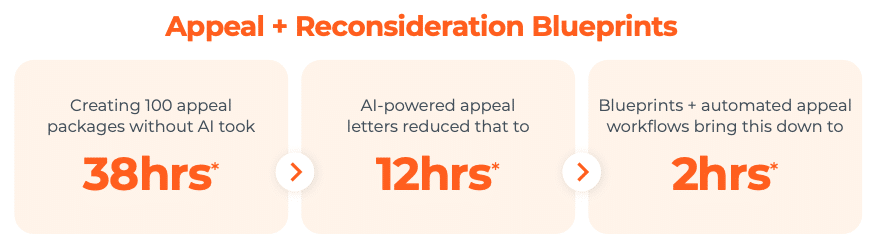
Appeal + Reconsideration Blueprints Creating 100 appeal packages without AI took 38hrs* AI-powered appeal letters reduced that to 12hrs* Blueprints + automated appeal workflows bring this down to 2hrs*


GENerative AI RESULTS IN RCM

Research + impact of AI in healthcare revenue cycle over time

This rise of AI in the healthcare revenue cycle industry is actively and fundamentally changing how organizations approach financial performance.

Recent research shows the trajectory.

In a 2024 study on AI adoption and ROI in healthcare payments by Modern Healthcare and Waystar:
  • Use: 69% of healthcare leaders were using AI somewhere in the revenue cycle, while 31% weren’t using it at all. Only 3% were using AI for more than half of RCM functions.
  • ROI: Of those using AI in RCM, 75% reported positive ROI.
  • Future investment: 100% of survey respondents saw the benefit of AI in RCM, and 90% planned to boost AI investments in the near future.
By 2025, active buyers and users of AI revealed to Forrester and Waystar where innovations were proving effective:
  • Gains: Respondents reported AI-related gains of 36% in workforce efficiency, 27% in denial prevention, and 18% in payment accuracy on average.
  • Trust: 60% trusted AI more after implementation than they had initially, while 18% said they were not concerned about the integrity of AI output at all.
  • Importance: 82% considered AI integral to their RCM operations, 70% treated it as a high or critical organizational priority, and 60% planned to increase AI investment.

In 2026, research drilled down on specific areas.
A deep dive into mid-cycle AI showed that connecting financial and clinical data yields results despite the fact many organizations can’t yet connect them:
  • Goal vs. reality: 100% of healthcare finance leaders are interested in a single AI-powered platform connecting the mid-cycle to the final claim, yet 86% lack true integration between those systems.
  • Success: Hospitals using Waystar’s AI-powered mid-cycle solutions achieved an 87% increase in CDI program impact, increased observation-to-inpatient conversion rates by 13%, and unlocked up to $3 million in incremental revenue per 10,000 admissions.
A comprehensive exploration of post-payment risk revealed the scale of the recoupment challenge, growing interest in AI and automation, and early evidence of their potential to improve recoupment management:
  • Challenge: 42% of hospitals and health systems reported $1 million+ in annual recoupment requests, yet 83% of healthcare organizations lacked full visibility into the root causes.
  • Adoption: One-third (33%) of respondents were currently using AI or automation in some capacity. Another 43% were actively evaluating solutions.
  • Early results: Using Waystar’s AI-powered solution, one client achieved an 86.5% recoupment match rate, reduced time spent per recoupment by 80%, and decreased complex PLB adjustments by 10%. 


GENerative AI RESULTS IN RCM

Reach new heights in healthcare with Waystar AltitudeAI™ 

Minimize effort.
Maximize efficiency.

Waystar AltitudeAI™ is purpose-built to automate work, prioritize tasks, and eliminate errors. Pervasive across the end-to-end software platform, our AI solutions drive efficiency and yield meaningful results for healthcare providers.

AgenticAI

GenerativeAI

PredictiveAI

Speak with an expert


FAQ

AI in healthcare revenue cycle management refers to the use of artificial intelligence — including generative AI, agentic AI, predictive analytics, and intelligent automation — to streamline the financial processes that span the entire revenue cycle. Applied across these workflows, AI in healthcare revenue cycle management helps reduce manual work, surface risk earlier, improve patient financial care, and accelerate reimbursement. Waystar AltitudeAI™ brings these capabilities together inside a single platform, with results that include a 70% time savings on appeal package creation, a 40% higher denial overturn rate, and more than $15 billion in denials prevented in under a year.1

1Waystar data.

Waystar AltitudeAI™ is a suite of AI-powered capabilities built into the Waystar platform to elevate productivity and accuracy across the healthcare revenue cycle. Built on Waystar’s robust data network, Waystar AltitudeAI™ anticipates challenges and proactively addresses inefficiencies to drive meaningful outcomes. It uses generative AI to autonomously draft appeal letters inside Waystar’s Denial + Appeal Management solution, automates repetitive revenue cycle tasks with an AI-powered assistant, and applies predictive analytics to forecast trends and surface potential denials before they happen. Recent results include a 70% time savings for appeal package creation and a 40% higher denial overturn rate.1

1Waystar data.

Generative AI does something traditional AI can’t — it creates new content instead of only analyzing what’s already there. In healthcare revenue cycle management, that opens up a range of use cases. Generative AI-powered software can:

  • Draft appeal letters for denied claims
  • Summarize clinical documentation and denial reasons
  • Generate patient-facing billing explanations
  • Power conversational assistants for staff and patients

Waystar AltitudeAI™ focuses generative AI RCM where it delivers the biggest time and revenue impact. For example, inside Waystar’s Denial + Appeal Management solution, it autonomously drafts appeal letters tailored to each denial. Trained on Waystar’s robust data network, it pulls from denial details, clinical documentation, and payer-specific requirements to produce ready-to-send letters in a fraction of the time. Creating 100 appeal packages used to take 38 hours manually. With AI-generated letters, it drops to 12 hours. 1 With Appeal + Reconsideration Blueprints, it drops to 2 hours.1

1Waystar data.

ROI from AI in RCM typically shows up in four places: faster appeal cycles, higher denial overturn rates, lower manual workload, and stronger revenue capture. Together, these translate into lower cost-to-collect, faster reimbursement, and more team capacity for complex work.

Waystar AltitudeAI™ has delivered appeal package creation 3 times faster, a 70% reduction in time per package, and a 40% higher denial overturn rate. Waystar AltitudeAI™–powered solutions have also helped prevent more than $15 billion in denials in under a year — concrete evidence of the financial impact AI can deliver at scale.1

Before deploying any AI solution, organizations should tie the investment to specific outcomes — like denial overturn rate, days in AR, cost-to-collect, and denial prevention — so ROI can be tracked from day one.

1Waystar data.

AI in healthcare RCM can be both highly secure and fully compliant when built on a strong foundation. Trusted vendors layer AI-specific safeguards, human oversight, and ongoing security testing — on top of established healthcare compliance frameworks.

Waystar AltitudeAI™ is built inside the same security and compliance program that protects the rest of the Waystar platform, which holds HITRUST CSF certification and SOC 2, PCI, and HIPAA compliance. Waystar AltitudeAI™ is in scope for Waystar’s 2026 HITRUST and SOC 2 + HIPAA assessments, and its agentic capabilities operate within defined guardrails and human oversight. When evaluating any AI vendor, providers should look at compliance certifications, data governance practices, AI-specific security testing, and how the vendor handles training data and PHI.

Share
Extra Grunge Rusty Pattern Background, vignetted
Newsletter

MONTHLY NEWSLETTER

Get Insight delivered to you every month